Home >Blog >Dropped Kerb Planning Permission: When You Need It
Dropped Kerb Planning Permission: When You Need It
BeforeBricks Marketing Team
•
A dropped kerb always needs consent from your highway authority, usually a vehicle crossing licence under section 184 of the Highways Act 1980. Planning permission may be needed as well in certain cases: for example where the road is a classified (A, B or C) road and your council requires permission first, where the property is a flat, maisonette or other building without permitted development rights for front gardens, where it is a listed building or in a designated area, or where the new driveway behind it is impermeable, does not drain to a lawn or border, and covers more than 5 square metres.
These are two separate approvals from two parts of the council, and getting one does not give you the other. Prospects regularly ask us whether a dropped kerb needs planning permission or only highways approval, so this guide sets out how to tell which you need.
Highways consent: always needed
You cannot drive across a footway without a dropped kerb. The Planning Portal is clear that doing so without one is illegal and that you must apply to your local authority. The council's power to approve a vehicle access comes from section 184 of the Highways Act 1980, as West Northamptonshire Council's dropped kerb page explains.
This highways approval is about the road and pavement: safety, visibility, junctions, street furniture and the construction of the crossing. It is normally a licence application to the highways team, not a planning application. West Northamptonshire Council, for example, only issues the licence to a contractor on its approved list.
When a dropped kerb also needs planning permission
Planning permission is a separate question about the development itself. These are the situations where you are most likely to need it.
Classified roads
If your property fronts an A, B or C road, check whether your council needs planning permission in place before it will consider a licence. West Northamptonshire Council states this directly: for access on a classified road, you must obtain planning permission from the planning department before applying for a licence.
Flats, maisonettes and other buildings
The permitted development allowances for front gardens set out by the Planning Portal do not apply to flats or maisonettes, or to converted houses and other buildings. Without those rights, creating a hard surface for parking is likely to need a planning application.
Listed buildings and protected areas
Government guidance notes that there are different requirements for listed buildings, and that permitted development rights are more restricted in designated areas such as conservation areas and National Parks. The Planning Portal adds that Article 4 Directions or planning conditions can also restrict permitted development rights. Check with your planning authority before you start.
The driveway behind the kerb
This is the one that catches people out. A dropped kerb is only useful with somewhere to park, and the hardstanding is controlled by planning rules:
- A new or replacement driveway of any size does not need planning permission if it uses permeable or porous surfacing, such as gravel, permeable block paving or porous asphalt.
- It also does not need permission if rainwater runs off to a lawn or border to drain naturally.
- A traditional, impermeable surface that does not drain to a permeable area needs planning permission if it covers more than 5 square metres.
The GOV.UK guidance on permeable surfacing of front gardens lists options including gravel, wheel tracks, reinforced grass, permeable block paving and soakaways. If you are unsure what else can be done without an application, our guide on what you can build without planning permission covers the wider rules.
Size and visibility rules vary by council
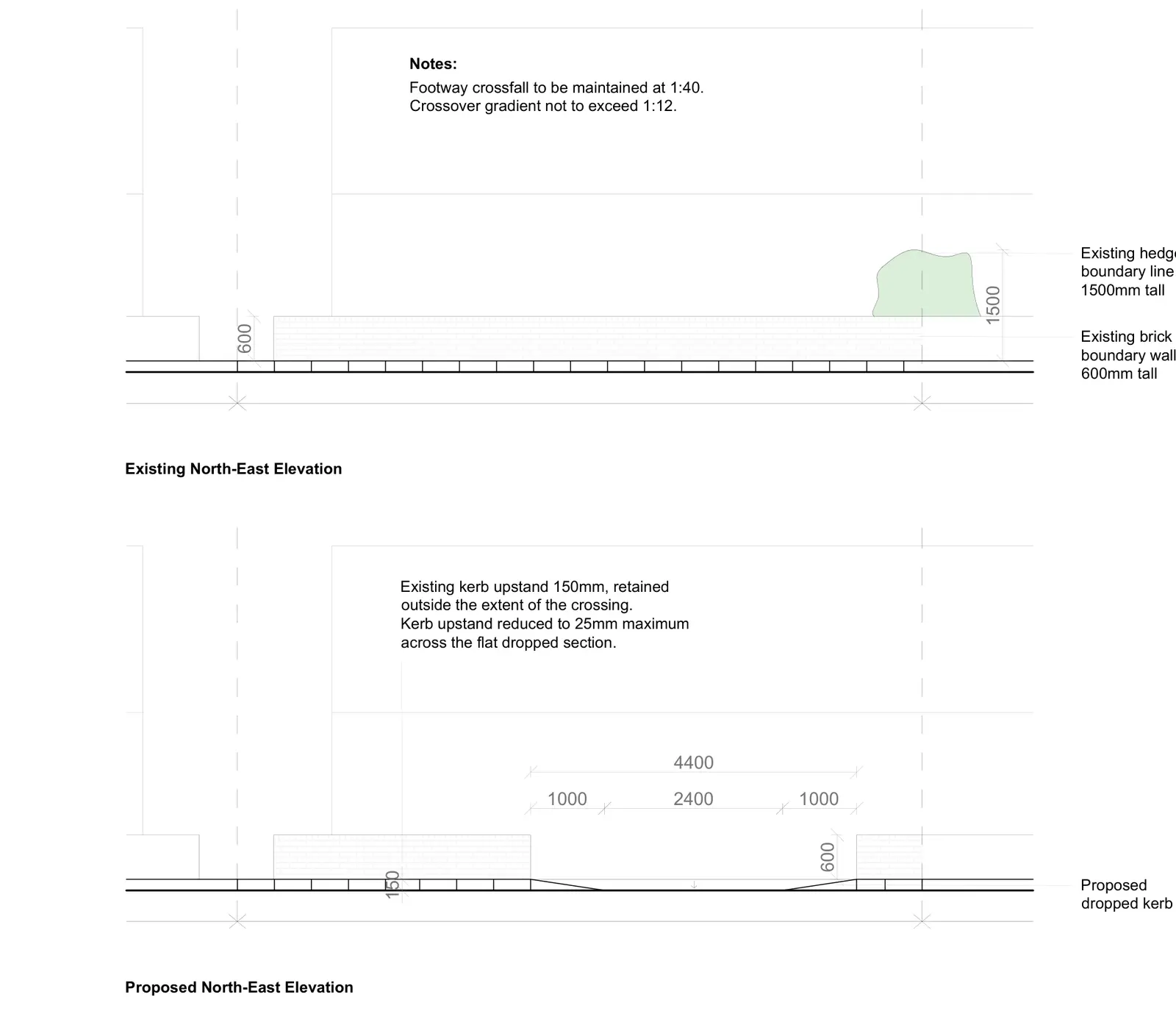
Each highway authority sets its own criteria for vehicle crossings, so always read your own council's guidance. As an example, West Northamptonshire Council's requirements include:
- An unobstructed parking area within the property of at least 5m deep by 3m wide.
- At least 3m at the boundary to form an entrance where sightlines are clear from 1.2m high, or a 5m wide entrance where they are not.
- The access at least 10m from a junction or sharp bend. Nameplates or street lights at the access point may be moved, but at your cost.
- Refusal where there is already an access, where it would exit into public parking such as a lay-by, where there is traffic calming, or where a tree trunk is closer than 1m.
The council says some criteria can be relaxed for Blue Badge holders. It charges a licence and inspection fee (£330 at the time of writing) when you apply, says a decision can take up to 28 days, and notes that works usually start 2 to 3 weeks after the licence is issued to your contractor. Other councils will have different figures, so treat these as an illustration rather than a rule.
A recent example from our approvals
In January 2026 West Northamptonshire Council approved a dropped kerb and off-road parking application that we prepared. It took about 7 weeks from validation to decision. That is the planning stage only; the highways licence is a separate step. For more on typical timescales, see how long a planning application takes.
How to approach it
- Check whether your road is classified, whether your property is a house, flat or listed building, and whether it is in a designated area. Our dropped kerb planning permission checker walks you through these questions.
- Decide on the driveway surface: permeable surfacing often avoids the need for planning permission for the hardstanding.
- Read your council's vehicle crossing criteria and measure your frontage against them.
- If planning permission is needed, get it before applying for the highways licence, as West Northamptonshire Council requires for classified roads.
Frequently asked questions
Do I need planning permission for a dropped kerb?
Not always. You always need consent from the highway authority to cross the pavement, but planning permission may also be needed if the road is classified (A, B or C) and your council requires it, the property is a flat, maisonette or other building without front garden permitted development rights, it is a listed building or in a designated area, or your new driveway is impermeable, does not drain to a lawn or border, and is over 5 square metres.
What is a classified road?
Classified roads are A, B and C roads. West Northamptonshire Council, for example, says you must get planning permission before applying for a dropped kerb licence on any of these.
How long does it take?
For the highways licence, West Northamptonshire Council says a decision can take up to 28 days, with works usually starting 2 to 3 weeks after the licence is issued. A recent dropped kerb and off-road parking planning application we handled there took about 7 weeks from validation to decision.
Can I drive over the pavement without a dropped kerb?
No. The Planning Portal states it is illegal to drive over a pavement without a dropped kerb, and you must apply to your local authority for one.
Not sure whether your dropped kerb needs planning permission? Book a free advice call and we will look at your road, property and frontage with you. You can also see our planning services.