Have a question?
Retrospective Planning Permission: How It Works

Retrospective Planning Permission: How It Works

BeforeBricks Marketing Team
•
function Copy() { var Url = document.getElementById("url"); Url.innerHTML = window.location.href; console.log(Url.innerHTML) Url.select(); document.execCommand("copy"); }

Paste:
November 25, 2026

Retrospective planning permission is planning permission you apply for after the work has already been done. Section 73A of the Town and Country Planning Act 1990 lets a council grant permission for development carried out before the application, including work done without permission or without complying with a planning condition. The council still judges it on its planning merits, so approval is never automatic.

This guide covers how councils handle unauthorised work, the time limits that apply, when a lawful development certificate is the better route, and what a retrospective application needs.

What retrospective planning permission covers

Section 73A says the planning permission a council can grant includes permission for development carried out before the date of the application. It applies to development carried out:

  • without planning permission;
  • in line with a permission granted for a limited period; or
  • without complying with a condition attached to a permission.

So it covers an extension built with no permission at all, a project that was built differently from the approved drawings, and a use that carried on after a temporary permission ran out. Under section 73A(3), the permission can take effect from the date the development was carried out.

Is building without planning permission illegal?

Government guidance on enforcement describes carrying out development without the required permission, or failing to comply with a condition, as a breach of planning control under section 171A of the 1990 Act. The council can take enforcement action against a breach.

The criminal offences the guidance describes come later in the process. For example, not complying with an enforcement notice once the compliance period has passed, with no appeal outstanding, is an offence that carries an unlimited fine. Failing to return a planning contravention notice within 21 days, or giving false or misleading information on one, is also an offence.

How councils handle unauthorised work

Enforcement is discretionary. The guidance says councils can act when they regard it as expedient, having regard to the development plan and other material considerations, and should act proportionately. It also says councils should usually avoid formal action where a breach is trivial or technical and causes no material harm, or where the development is acceptable and action would only regularise it. The same guidance is clear that nothing in it condones a wilful breach of planning law.

A council can invite you to submit a retrospective application. It cannot be assumed that permission will be granted, and the council may still issue an enforcement notice for other parts of the development. The invitation can be formalised with an enforcement warning notice, which councils can issue where the unauthorised development has a reasonable prospect of being acceptable. There is no right of appeal against an enforcement warning notice, and ignoring one opens the way to further enforcement.
You usually get one chance to seek permission after the event

The guidance says an owner has one opportunity to seek permission after the work: either a section 73A application or an appeal against an enforcement notice on ground (a), which argues that permission should be granted. A council can decline to determine a retrospective application if an enforcement notice has already been issued.

For enforcement notices issued on or after 25 April 2024, a ground (a) appeal is not available if the notice was issued after a related retrospective application was made and within two years of that application ceasing to be under consideration. In practice, that makes the retrospective application the moment to put the strongest case forward, with proper drawings and a clear explanation of why the development is acceptable.

The time limits for enforcement

Development generally becomes immune from enforcement if no action is taken within set periods. Under the current guidance:

  • Building work substantially completed on or after 25 April 2024: 10 years.
  • Building work substantially completed before 25 April 2024: 4 years.
  • A change of use to a single dwellinghouse on or after 25 April 2024: 10 years; before that date, 4 years.
  • Other changes of use: 10 years.

There are exceptions. A council can take further action on the same breach within four years of earlier action, even if the normal period has run out. Where a breach has been deliberately concealed, the council may still act out of time or seek a planning enforcement order. The older "four year rule" therefore only helps with building work substantially completed, or a change of use to a single dwellinghouse made, before 25 April 2024.

Get a Quick Quote

0
people filled this out in the last hour
By submitting the form you agree to our privacy policy.
Thank you! Your submission has been received!
Oops! Something went wrong while submitting the form.

When a lawful development certificate is the better route

If the time limit has passed, or the work never needed planning permission in the first place, you may not need retrospective permission at all. Instead you can apply for a lawful development certificate for an existing use or development under section 191.

A retrospective application asks the council to judge whether the development is acceptable. A certificate application is about facts: GOV.UK guidance says the applicant must provide enough information, and the evidence must justify the certificate on the balance of probability. If the council has no evidence that contradicts your account or makes it less than probable, and your evidence is precise and unambiguous, the guidance says there is no good reason to refuse. A refusal does not stop you applying again later if you can produce more information.

A certificate only describes the position at the date of the application, so it needs a precise description of what is on the land, not just a general label.

What a retrospective application needs

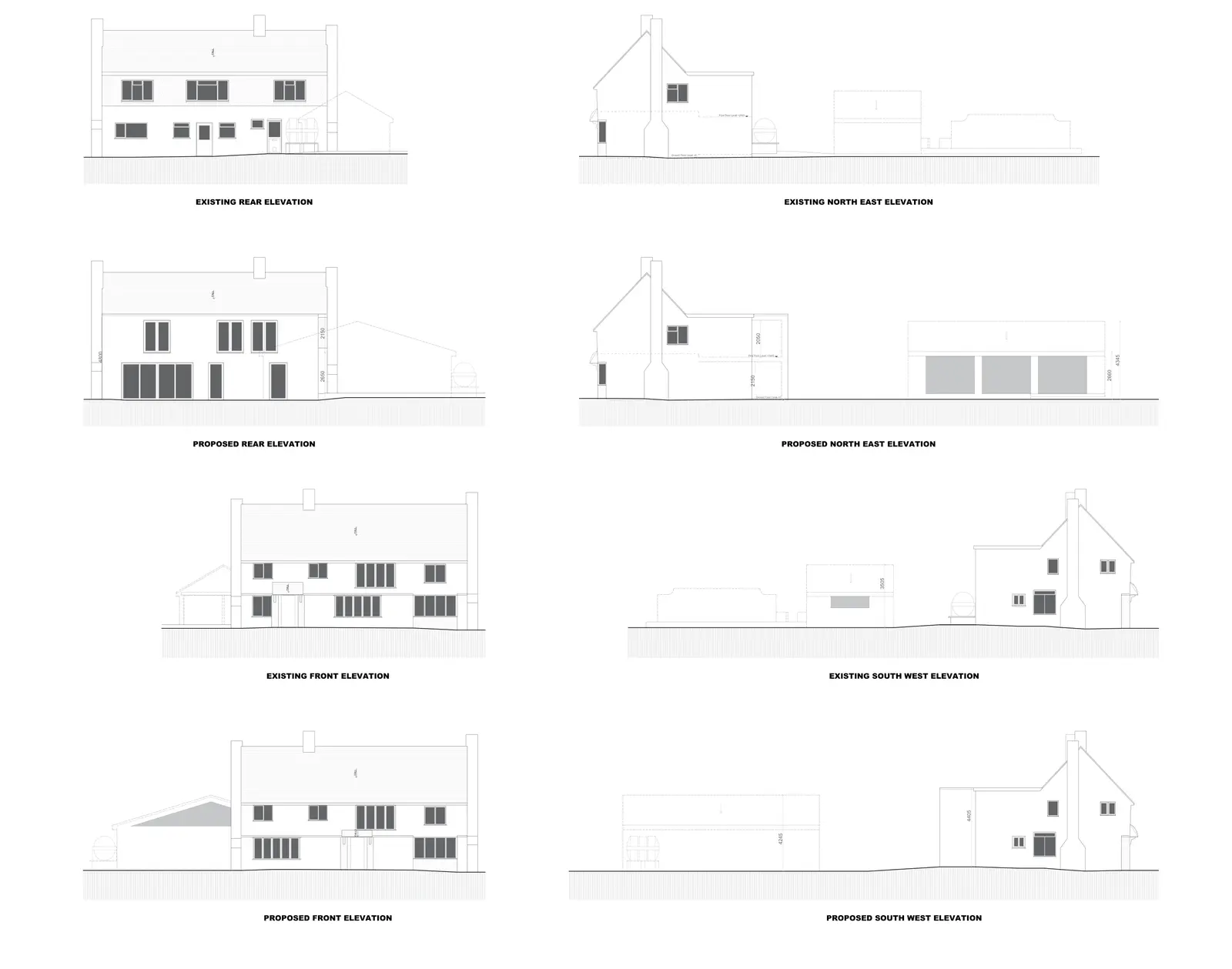
A retrospective application follows the same route as any other application of its type. For a house, that usually means a householder planning application with drawings, a site location plan and the council's other validation requirements. The big difference is that the drawings must show what has actually been built, not what was intended.

From the retrospective enquiries we see, a few points come up again and again:

  • A council letter usually starts it. Many people contact us after the council has written to them, often with a deadline to respond. Send your designer every letter you have received, because the deadline shapes the plan.
  • Photos come first. The first thing we ask for is a set of photos of what was built, so we can judge the likely route before anyone draws anything.
  • As-built accuracy matters. If the work was built differently from approved plans, the drawings need to record the differences exactly. A measured survey is often the starting point.
  • Validation catches people out. Some applications reach us after being returned as invalid, for example because the red line on the site location plan did not cover the whole site. Larger rural schemes can also need ecology and biodiversity net gain information.

If the site is in a Community Infrastructure Levy charging area, the guidance notes that a retrospective permission generally will not qualify for relief or exemption, other than the minor development exemption. It is worth checking this early on larger schemes.

If a retrospective application is refused

A refusal can be appealed, but the deadlines are set out on the decision notice and are shorter where an enforcement notice has been served on the same land. Read the notice as soon as it arrives. Before appealing, look at the reasons for refusal: it may be more practical to change the development to address them and apply again. Our guide to section 73 applications covers changing conditions on a permission you already have.

Frequently asked questions

Can I get retrospective planning permission after 4 years?

Yes, you can apply at any time. But if building work was substantially completed before 25 April 2024 and four years have passed without enforcement action, it may already be immune, and a lawful development certificate could be the better route. For work completed on or after 25 April 2024, the period is 10 years.

Does a retrospective application stop enforcement?

Not automatically. Government guidance says a council that invites a retrospective application may still issue an enforcement notice for other parts of the development, and it can decline to determine a retrospective application if an enforcement notice has already been issued.

Is retrospective planning permission always granted?

No. Government guidance says it cannot be assumed that permission will be granted. The council judges the development on its planning merits.

Talk it through with us

If you have had a letter from the council, or you have found out that work at your property needed permission, we can look at what was built and tell you honestly which route fits. Book a free advice call and send us the photos and any letters you have.